In my opinion, Sunday afternoons have so much room for opportunity. If you take a look at the grand scheme of a weekend, Sundays are the “leg room”, so to speak. On Sunday, January 6th at 3:00 pm, I took advantage of that “leg room” and drove down with my mom to the Steppenwolf Theatre to see the production of “Familiar” written by Danai Gurira. Because I was a student, I was able to get my ticket for $15 with proof of my student ID, and my mom got her ticket half off because we arrived at the box office an hour before the house opened (just a little tip!). Following the show, I stayed for a talk-back with the PR Assistant of the theatre and I will be including things that were said throughout!
I had never been to the Steppenwolf Theatre, so I walked in with absolutely no expectations whatsoever. What immediately grabbed my attention was the true diversity of the audience members. In the irony of the show title, that kind of ambiance was unfamiliar to me which I thought was interesting. I would say that the majority of them were over 30, and a large handful of the audience was African-American, or at least of African-American descent.
“Familiar” is about a Zimbabwean family who lives in Minnesota. Marvy and Donald, the parents, are immigrants born and raised in Zimbabwe, but they discovered that their country wasn’t safe anymore and decided to move them and their family to a suburb of Minnesota. The eldest daughter, Tendi, is preparing to get married to a white Christian man named Chris. Tendi is Christian as well, but right off the bat, there is obvious tension. As an audience, we simply begin to recognize the difficulty of juggling staying close to the Zimbabwean culture versus abandoning the old culture for the new one that is to be built through marriage.
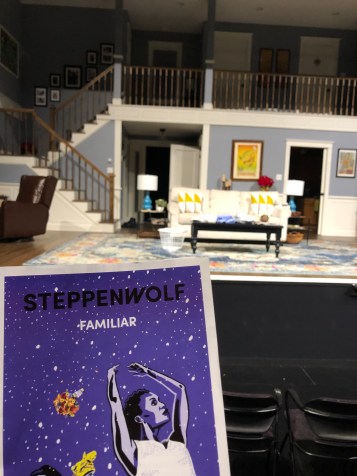
The playbill with the set in the background
On top of the difficulty that comes with marrying into a family of a different culture, we learn as an audience that the youngest daughter, Nyasha, has a lot of trouble fitting in in her family. In the first scene, Nyasha returns to Minnesota after visiting Zimbabwe for a trip. Identifying with the Zimbabwe culture is difficult for her because even though she wasn’t born there, it is still in her roots. She has their recognizable skin tone and hair color but because she wasn’t born there, she doesn’t have an accent or even speak their language. Again in the irony of the show title, she has trouble finding the boundary line.
The very last thing said at the talk-back was how this man interpreted the title “Familiar” in a different way than others. He thought that because Nyasha was in Zimbabwe, she felt a familiarity of being “at home” and back in her roots, but it was unfamiliar not speaking their language or even sounding like the fellow people.
During Act 2, we delve way more into the story of this family and the true rooting of their culture, values, and beliefs. With help from Donald, the father, he and Tendi plan to fly Auntie Anne, Marvy’s sister, in from Zimbabwe to conduct a traditional Zimbabwean wedding ceremony called a “Roora”. A roora is a ceremony that is held in order to acquire your new wife, but because Tendi’s fiancee isn’t of Zimbabwean descent or even remotely close to this culture, it is difficult for him to understand or feel like he fits in. Throughout the majority of the play, we get to see all different sides of the immediate family in their frustrations before the wedding, yet I felt like I didn’t quite focus enough of my attention on how Chris, the groom-to-be, must be feeling.
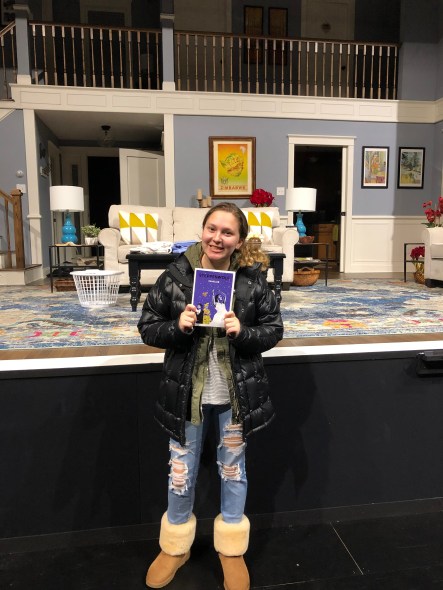
Me after the talk-back getting a closer look at the set
Seeing Chris at that moment and watching him trying his best to adapt to Tendi’s cultures and traditions made me think of what it’s like to be Jewish, especially in this day in age and in my town. Having been born and raised in a Jewish household, with both of my parents being Jewish as well as my grandparents, there is a lot riding on me marrying a Jew. The fear is that if I don’t marry a Jew, my kids won’t have a bar/bat mitzvah, we won’t get to light candles for 8 nights during Hanukkah, or experience high holidays and Passover. It made me really step out of my shoes and realize how frustrating and difficult it could be if I married someone of a different culture or religion but still was very intent on keeping the traditions that had been relevant for me since birth.
“It is very difficult to give up our certainties — our positions, our beliefs, our explanations. These help define us; they lie at the heart of our personal identity. Yet I believe we will succeed in changing this world only if we can think and work together in new ways. Curiosity is what we need. We don’t have to let go of what we believe, but we do need to be curious about what someone else believes. We do need to acknowledge that their way of interpreting the world might be essential to our survival,” (1).
Wheatley says herself that giving up what we are so used to being surrounded by can be incredibly difficult. I think that this quote fits the synopsis of the show perfectly. In order to successfully and powerfully change the world, we have to begin accepting other cultures, beliefs, races, religions, etc. She also makes it very clear that we as humans can’t get two concepts confused. There is a difference between keeping what we believe and altering it to fit others as well, versus totally letting go of a part of ourselves for the benefit and success of someone else. The last sentence, however, fits “Familiar” to a tee. Tendi is in love with Chris. She didn’t fall for his culture or values, she fell for him. That is the most powerful form of love and they can not survive without each other until both cultures are recognized, appreciated and followed.
“Familiar” was a beyond incredible show with such a powerful message that can relate to a majority of people, not just those of or relating to African-American descent. This show gave me the hope that my generation will be the one to change the standards and stereotypes of marriage. It is such an apparent issue that is very relevant in our world today, yet it is an issue that can become so easily hidden or covered. This performance gave me a whole new outlook on life, and how we truly have to let ourselves be vulnerable to other cultures and ideas to then accept and love others.
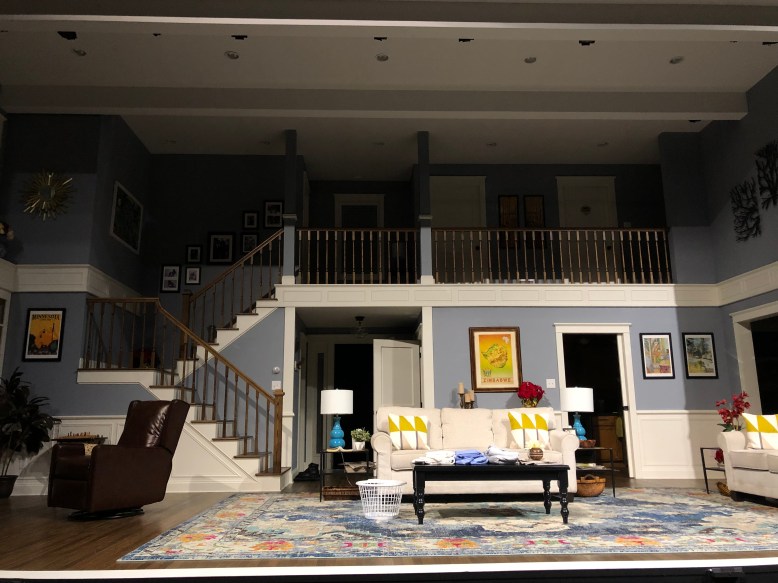
The beautiful and intricate set of the show, designed by Kristen Robinson
 Alison's Adventures